These words come from some anarchists in the territories dominated by the colombian state on recent developments in the territory but reading them they felt eerily familiar and for this reason I have chosen to publish them here. This is a machine translation so keep that in mind. See the bottom of the post for the original.
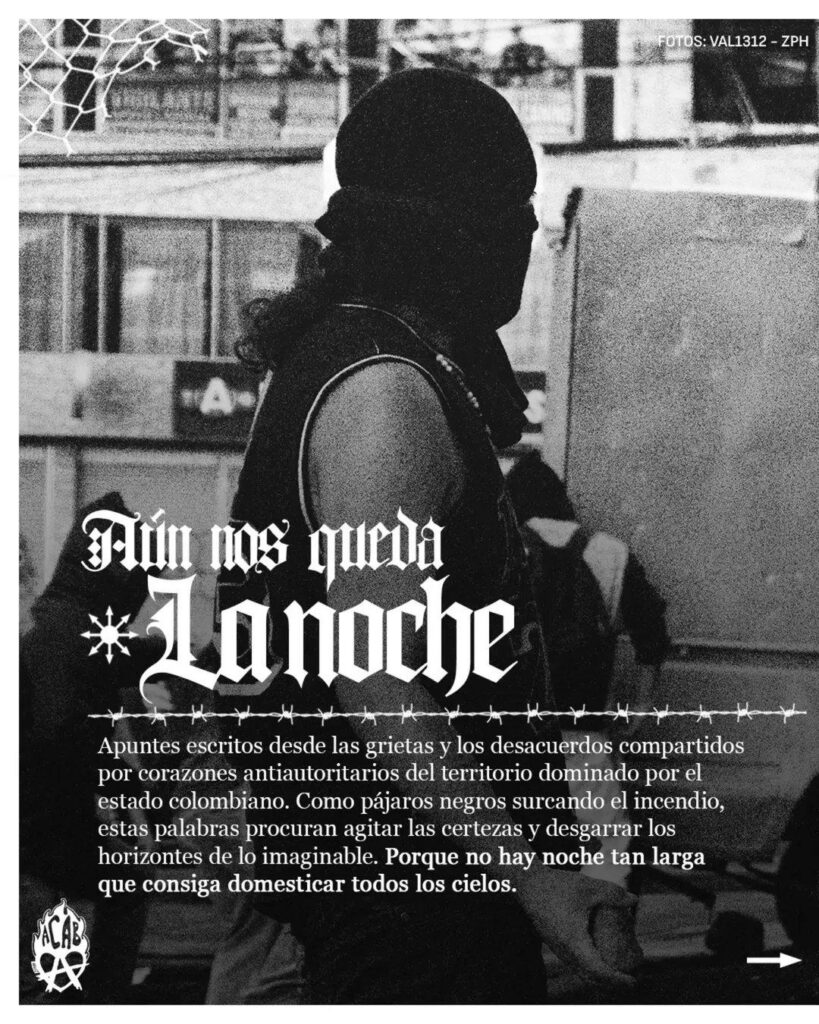
Notes written from the cracks and disagreements shared by anti-authoritarian hearts in the territory dominated by the Colombian state. Like black birds soaring through the fire, these words seek to shake up certainties and tear apart the horizons of the imaginable.
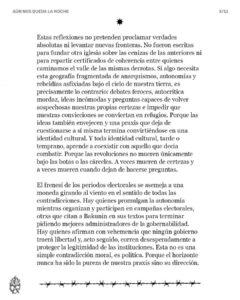
These reflections do not seek to proclaim absolute truths or to erect new boundaries. They were not written to found another church on the ashes of previous ones, nor to hand out certificates of consistency among those of us who walk through the valley of the same defeats. If there is one thing this fragmented landscape of anarchisms, autonomies, and rebellions—suffocated under the sky of our land—needs, it is precisely the opposite: fierce debates, scathing self-criticism, uncomfortable ideas, and questions capable of casting doubt on our own certainties and preventing our convictions from becoming refuges. Because ideas also grow old, and a praxis that ceases to question itself eventually becomes a cultural identity. And every cultural identity, sooner or later, learns to coexist with the very thing it claimed to fight. Because revolutions do not die solely under the boots of oppressors or in prisons. Sometimes they die of certainties, and sometimes they die when they stop asking questions.
The frenzy of election seasons resembles a coin spinning in the wind, embodying all manner of contradictions. There are those who advocate for autonomy while organizing and participating in election campaigns, and others who quote Bakunin in their writings only to end up calling for better administrators of governance. There are those who vehemently assert that no government will bring freedom and, immediately afterward, rush desperately to protect the legitimacy of institutions. This is not a simple moral contradiction; it is a political one. Because the horizon has never been the purity of our praxis but rather its direction.
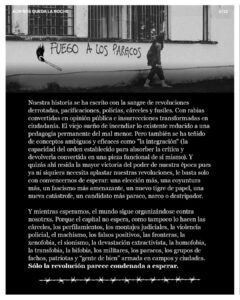
Our history has been written with the blood of defeated revolutions, pacification campaigns, police, prisons, and guns. With rage turned into public opinion and insurrections transformed into citizenship. The old dream of setting the status quo ablaze has been reduced to a perpetual lesson in the lesser evil. But it has also been tainted by ambiguous yet effective concepts such as “integration” (the established order’s ability to absorb criticism and return it transformed into a functional part of itself). And perhaps therein lies the greatest victory of the powers that be in our time, for they no longer even need to crush our revolutions; it is enough simply to convince us to wait: one more election, one more turning point, one more threatening form of fascism, a new paper tiger, a new catastrophe, one more candidate who is a paramilitary, a drug trafficker, or a butcher.
And while we wait, the world continues to organize against us. Because capital doesn’t wait—nor do prisons, profiling, judicial setups, police violence, machismo, false positives, borders, xenophobia, Zionism, extractivist devastation, homophobia, transphobia, biphobia, the military, the paramilitaries, the fascist groups, “patriots,” and “upstanding citizens” armed in rural areas and cities. Only the revolution seems doomed to wait.
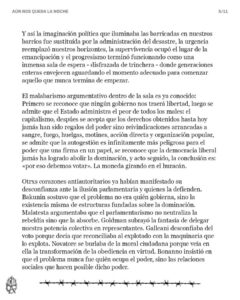
And so the political imagination that lit up the barricades in our neighborhoods was replaced by the management of disaster; urgency took the place of our horizons; survival supplanted emancipation; and progressivism ended up functioning as a vast waiting room—disguised as a trench—where entire generations grow old waiting for the right moment to begin what never quite gets started.
The argumentative juggling act within that waiting room is now well known: First, we acknowledge that no government will bring us freedom; then we admit that the state manages the worst of all evils—capitalism; then it is accepted that the rights won to date have never been gifts from those in power but rather demands wrested through blood, fire, strikes, riots, direct action, and popular organization; it is admitted that self-management is infinitely more dangerous to those in power than a signature on a piece of paper; it is recognized that liberal democracy has never succeeded in abolishing domination; and immediately afterward, the conclusion is: “That is why we must vote.” The coin spinning in the hurricane.
Other anti-authoritarian voices had already expressed their distrust of the parliamentary illusion and those who defend it. Bakunin maintained that the problem was not who governs, but the very existence of structures founded on domination. Malatesta argued that parliamentarism does not neutralize rebellion but rather absorbs it. Goldman highlighted the fantasy of delegating our collective power to representatives. Galleani distrusted the vote because he said it reconciled the exploited with the machinery that exploits them. Novatore mocked civic morality because he saw in it the transformation of obedience into virtue. Bonanno insisted that the problem was never who holds power, but rather the social relations that make such power possible.
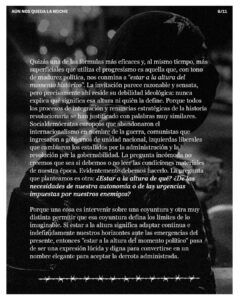
Perhaps one of the most effective—and at the same time, most superficial—formulas used by progressivism is the one that, in a tone of political maturity, urges us to “rise to the occasion of this historic moment.” The invitation seems reasonable and sensible, but that is precisely where its ideological weakness lies: it never explains what “rise to the occasion” means or who defines it. Because all the processes of integration and strategic concessions in revolutionary history have been justified with very similar words. European social democrats who abandoned internationalism in the name of war, communists who joined national unity governments, liberal leftists who traded upheaval for administration and revolution for governability. We do not believe the uncomfortable question is whether or not we should analyze the material conditions of our era. Obviously, we must do so. The question we pose is another: To rise to the occasion of what? Of the needs of our autonomy, or of the urgencies imposed by our enemies?
Because it is one thing to intervene in a given situation and quite another to allow that situation to define the limits of the imaginable. If rising to the occasion means continuously and indefinitely adapting our horizons to the emergencies of the present, then “rising to the occasion of the political moment” ceases to be a lucid and dignified expression and becomes an elegant euphemism for accepting an administered defeat.
And it is precisely from this fallacy that an even more baffling one arises: the idea that anyone who does not participate in the “sacred electoral ritual” automatically becomes passive, indifferent, or an accomplice to fascism. As if the entire history of popular struggles could be reduced to the electoral circus, or as if, all over the world, entire generations of anarchists, revolutionary unionists, and insurrectionists had remained inactive simply because they distrusted elections and their parties. The true ideological victory of liberal democracy lies in having reduced our entire political imagination to the logic of the state and all direct or antifascist action to marking a ballot with an X, presenting an absurd and unjust caricature: Either you vote, or you do nothing.
But the history that has been collectively woven in our neighborhoods and territories through mutual aid, art, critical pedagogy, popular education, community kitchens, sabotage, liberation, solidarity networks, direct action, combative memory, territorial organization, and street struggle proves exactly the opposite.
True passivity begins when our collective power and imagination are replaced every four years by hope placed in bourgeois representatives, when community organization becomes mere expectation, and when the struggle against fascism and authority is reduced to an electoral ritual carried out by rusty organizations that return all political centrality to the very figures and structures that produced the material conditions for their emergence.
There will be those who challenge these reflections by criticizing a supposed urban comfort detached from territorial barbarism, but ideas do not become true or false based on the social background of those who articulate them. It is nonetheless ironic to imagine that fascism, paramilitarism, drug trafficking, war, or devastation exist only far from cities. As if repression, authoritarianism, violence, or precariousness were the exclusive domain of other territories. But even if that were the case, anarchist thought has never been defined by the search for safe havens, but rather by a solidarity-based compassion that transcends mere survival.
The question has never been who will suffer first or who possesses more privileges, but rather how to combat barbarism without using the very tools of the master who enslaves us. Because the neo-fascist abyss into which we have just descended did not arise from a vacuum nor did it fall from the sky. It is the offspring of capitalism, nationalism, colonialism, and organized misery—and also the offspring of perfectly functional democracies, even progressive ones.
We were taught to fear chaos, but never obedience; we were taught to suspect the fire, but never the building that has been burning over our bodies for centuries; we were taught to distrust revolt, but never wage labor, borders, the police, prisons, and the daily devastation wrought by capital; we were taught to be afraid of the violence of the oppressed, but not the organized violence of those who oppress us.
But even among those who today—caught up in the contradictions of our times—legitimized voting to stem the reactionary tide, there are common enemies deeper than any temporary situation. The fascist uprising, populism, repression, patriarchy, and capitalist devastation are a reality today and are embodied in a narco-paramilitary figure as head of state. With a face, we won; with a stamp, we lost.
And when the terror of the past once again descends upon our bodies and territories, tactical differences have never prevented anarchists, autonomists, and insurrectionists from reappearing where we have always been: in the streets, at the barricades, at the communal potluck, in mutual aid networks, in solidarity, in the defense of those who fall, on the front lines. Not to administer defeat or manage disaster, but to fight.
Because beyond tactical differences, fascism has never been defeated at the ballot box; it is defeated through collective struggle, through solidarity, through our ability to reconnect and set traps to make the ground uninhabitable for reactionaries, and through the daily reconstruction of relationships that are incompatible with fear, obedience, and domination. This does not mean ignoring the gravity of the threats and violence looming over our territories, but it does compel us to ask an uncomfortable question that cuts across the breadth of our horizons:
If the urgency of the moment always ends up justifying the legitimization of power, at what exact moment does it cease to be a tactical exception and become a strategic surrender? Because if the answer is “someday, later on,” history has a rather cruel piece of news: That day almost never comes.
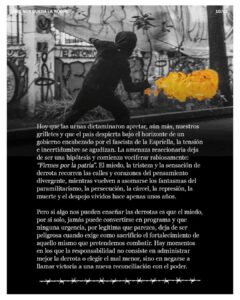
Now that the polls have ruled to tighten our shackles even further, and as the country awakens under the shadow of a government led by the fascist Espriella, tension and uncertainty are mounting. The reactionary threat is no longer a mere hypothesis; it is now screaming furiously: “Stand firm for the homeland.” Fear, sadness, and a sense of defeat sweep through the streets and hearts of those who think differently, while the ghosts of paramilitarism, persecution, imprisonment, repression, death, and dispossession—experienced just a few years ago—reappear.
But if defeats can teach us anything, it is that fear, on its own, can never become a program, and that no urgency—however legitimate it may seem—ceases to be dangerous when it demands, as a sacrifice, the strengthening of the very thing we seek to combat. There are moments when responsibility does not consist in better managing defeat or choosing the lesser evil, but in refusing to call a new reconciliation with power a victory.
Now that night has fallen and we are adrift on uncertain rivers, perhaps the black star that was always present on the horizon will shine once more to show us that what sustained us was never a government, nor being in the majority, nor the eternal promise of “change,” but rather the infinite invisible networks that survived death, the bonds woven in defeat, the bodies and communities that learned to resist, even when all seemed lost. And perhaps it is precisely now, as sadness replaces hope, that we will remember once again that our principles were never mere window dressing for peaceful times, but a compass (pointing in every direction) to guide us through the twilight.
Even so, when the backlash advances, when the ripper tears us apart, when fascism unfolds, and when repression once again shows its harshest face, there we will find ourselves once more—those of us who chose different weapons to attack and combat the same barbarism.
Because we are always reborn from the ruins and the fire, and even when defeated, persecuted, or cornered, there is an unyielding dignity in refusing to call the management of fear the horizon. And because above the disputes, contradictions, and differences over forms, there is something that has never belonged to institutions or electoral calendars:
Solidarity among those of us who are not willing to obey.
Perhaps it is precisely there, in the ruins, in the night that remains to us, where the possibility of a new world continues to beat.